 Founders Cable
 Free book: Africa’s Billion-Dollar Gaps
Why African Startups Fail: Running Out of Money Is the Last Thing That Happens
 By Samuel Cole, founder of Founders Cable · 17 November 2026 · 10 min read
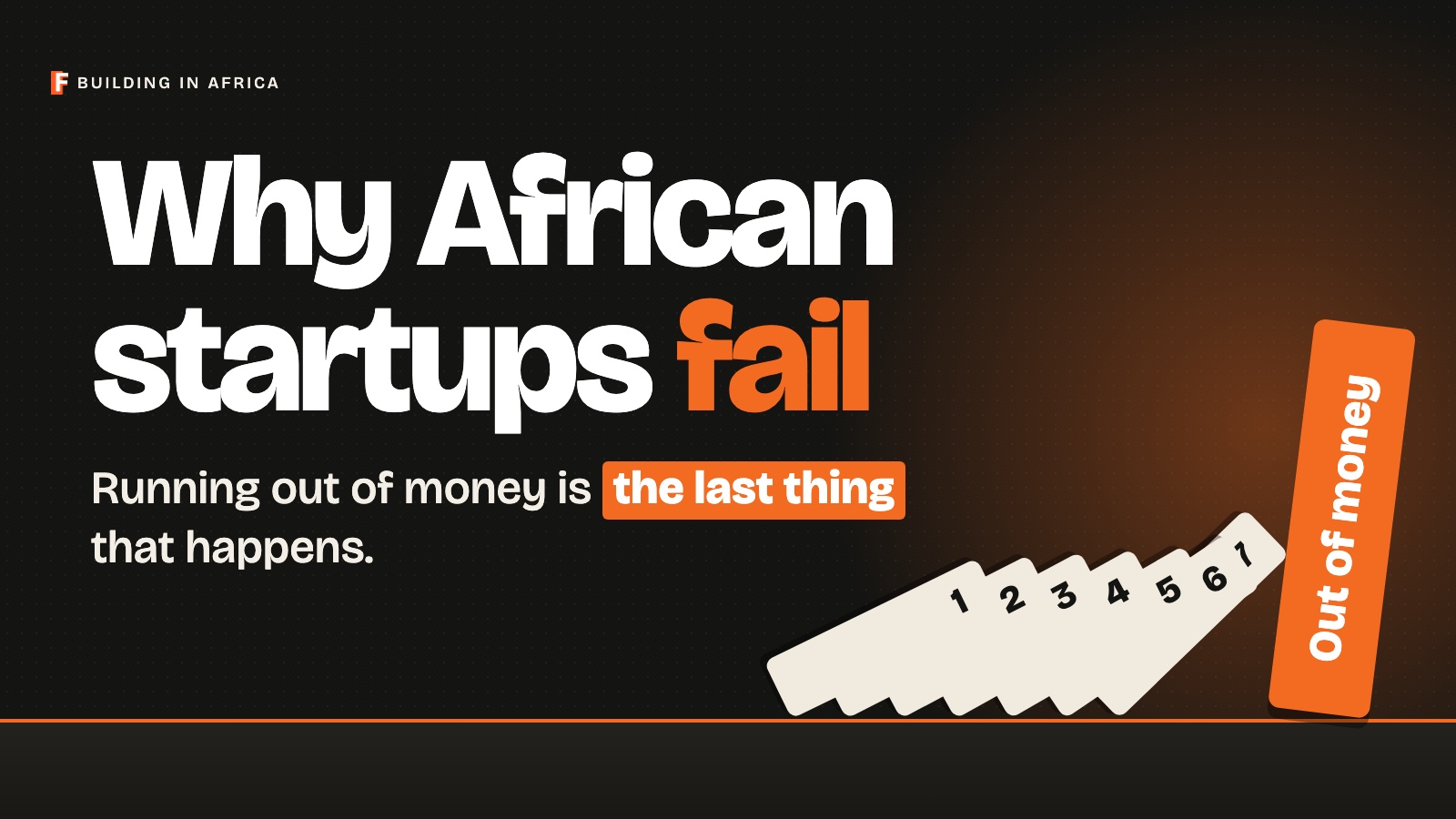
African startups rarely die from one thing. Running out of money is usually the last step, not the cause. Before that, deeper problems show up: a product too few people pay for, costs in dollars while sales come in local money, growing before the first market works, and weak control over the numbers.
Okra shows money is not the whole story. When the Nigerian fintech closed in 2025, it still had money in the bank. It said it would return up to about $5.5 million of unspent funds to its investors (Silicon Africa, The Paypers). Something else broke first.
Below are the seven causes that show up again and again in African shutdowns. For most of them, we show a company it hurt and an African company that did the opposite and won.
Why do African startups really fail?
Most shutdown stories say the same thing: "they ran out of money." Money runs out because something underneath stopped working. The customers didn't pay enough. The costs grew faster than sales. The team spread itself across too many places. Or nobody was watching the numbers closely.
Funding got harder after 2022, and raising took longer, according to WeeTracker's review of 2025 (WeeTracker). You can see where African funding is going now in our funding data. That made every weakness below more dangerous. A company with a hidden problem used to be able to raise its way past it. Now it can't.
The 7 causes, and who did the opposite
1. They built something people liked but wouldn't pay for
People can love a product and still never pay for it. Downloads, likes and sign-ups feel like demand. They are not. Demand is someone handing over money, again and again.
Who did the opposite: M-Pesa. When Safaricom launched M-Pesa in Kenya in 2007, the first idea was to help people repay small loans. Then the team noticed customers were using it to send money to family. According to Vodafone's own account of the story, they followed the customers instead of the plan (Vodafone). People were already paying to move money, often by handing cash to bus drivers (The EastAfrican). M-Pesa charged for something they already did. Safaricom says about 40 million people in Kenya now use M-Pesa every month (The Star).
The lesson: find what people already pay for, badly, and do it better.
2. The numbers only worked with investor money
Some businesses lose money on every sale and plan to fix it "at scale." In Africa, scale often never comes fast enough, and the investor money runs out first.
Who it hit: Copia. The Kenyan e-commerce company delivered goods to customers in towns and villages. It grew fast and relied on new funding rounds to keep going. In May 2024, after failing to raise more money, it went into administration and cut more than 1,000 jobs. In July, it gave up on reviving the business and began selling its assets to pay creditors. In September 2026, a Kenyan court formally ordered it into liquidation. In our reading, that is the pattern: when a business needs fresh funding to survive, one failed round can end it (TechCabal, TechCabal, Techpoint, TechCabal).
Who did the opposite: M-KOPA. M-KOPA sold solar home systems to families without power in Kenya. Instead of asking for the full price, it took a deposit and then small daily payments by M-Pesa, about 40 Kenyan shillings a day. If the payments stopped, the system switched off. Customers owned it after about a year (African Business, GSMA). Money came in every day, from customers, not just from investors.
The lesson: know how much you make on one sale. If the answer is "nothing yet," fix that before you grow.
3. Their costs were in dollars, but their sales were in local money
Many African startups pay for software, cloud servers and imported stock in dollars. They earn in naira, cedis, shillings or rand. When the local currency falls, costs jump overnight while prices stay the same.
Who it hit: Okra. Okra helped apps connect to Nigerian bank accounts. As the naira weakened, its cloud bills climbed. Its co-founder said that apart from salaries, cloud services took up most of the company's revenue. Okra even built its own cloud product to fight the problem. Costs were one pressure among several. Okra said strategy and market problems, not a lack of cash, led to its closure in 2025 (Silicon Africa, Nairametrics, Launch Base Africa).
Who did the opposite: Indomie in Nigeria. Tolaram started by importing Indomie noodles into Nigeria in 1988. Over time it built its own distribution network inside Nigeria and made the noodles there, so more of its costs sat in the same currency as its sales (Christensen Institute).
The lesson: list every cost you pay in dollars. For each one, ask if there is a local option, or if you can charge in a way that keeps up with the exchange rate.
4. They expanded before home was working
New countries look like growth. Often they are a second set of problems, paid for with the money the first market needed.
Who it hit: Lidya. The Nigerian lender for small businesses expanded into Poland and the Czech Republic around 2020. It left both in 2023 to "refocus on Nigeria." In 2024, customers began complaining about frozen funds, and its CTO and CEO left. Lidya shut down in October 2025 after raising about $16.45 million (Dabafinance, BusinessDay, The Condia). Copia went through something similar. In April 2023 it closed its Uganda business, two years after launching there, and cut between 300 and 350 jobs to focus on Kenya (TechCabal, Bloomberg).
The lesson: win one market so clearly that you know exactly why you won. Then copy it somewhere else.
5. Nobody was watching the numbers closely
Investors, staff and customers all rely on the numbers a company reports. When those numbers are weak or wrong, trust breaks fast, and money goes with it.
Who it hit: Dash. The Ghanaian fintech raised about $86.1 million in five years and closed in October 2023. Graphic Online reported that internal audits found its user numbers had been exaggerated (TechCabal, Graphic Online).
The lesson: this one has no famous winner, because good control is boring. Keep one honest dashboard of sales, costs and cash. Look at it every week. Share the real numbers with your team and investors, even when they are bad.
6. They built for power, roads and payments that weren't there
A plan that works with steady power, good roads and easy payments can collapse when one of them fails.
Who it hit: Inseco. The Cape Town company farmed insects for protein and raised a $5.3 million seed round in 2022. South Africa's power cuts, known as load shedding, hit its production hard. Its founder also named fast growth and bad hires as causes. Inseco shut down in 2025 (Launch Base Africa, Startup Researcher).
Who did the opposite: Tecno and itel. Transsion, the company behind Tecno, itel and Infinix, built phones for how people in Africa actually live. It treated power cuts as part of the design, so big batteries became a priority, and it kept prices low by selling huge volumes on thin margins (CKGSB Knowledge, TechCabal). By 2025 it sold about half of all smartphones in Africa (Canalys).
The lesson: plan for the bad day. Ask what happens to your business when the power is off for a week, a road is closed, or a payment app goes down.
7. They raised money instead of finding customers
Raising money can feel like progress. It is not the same as a business. Some founders spend a year chasing investors when a few months of selling would have told them if the idea works.
Imagined example, to show the pattern: Ada wants to build an app for hair salons. She spends eight months pitching investors and gets nothing. Her friend Kemi has the same idea. She walks into ten salons, offers to manage their bookings on WhatsApp for ₦5,000 a month, and gets four paying customers in two weeks. Kemi now knows what salons will pay for. Ada still doesn't.
The lesson: customers first, capital second. Paying customers are also the best thing you can show an investor later.
Do small businesses in Africa fail for the same reasons?
Mostly, yes. A small shop or service business rarely raises investor money, but it fails for causes 1, 2, 3 and 6 above. It dies when it sells something too few people pay for, prices below its costs, gets hit by currency swings on imported stock, or loses days of work to power cuts. The fixes are the same, just smaller.
How can you tell if your business is heading there?
Answer these five questions honestly:
- Do customers pay you, again, without you chasing them?
- Do you make money on each sale, after all costs?
- Do you know which of your costs are in dollars?
- Is your first market clearly working before you add another?
- Do you look at your real sales, costs and cash every week?
If you answered no to two or more, that is your work for the next three months. Start with your first paying customers (how to get them). If you answered yes to at least four and you are thinking about raising, RaiseScore shows how ready you are and what to fix first. It is free and takes a few minutes.
What did the winners do instead?
Look at the winners in this article. M-Pesa charged for something people already did. M-KOPA got paid by customers every day. Indomie built close to its customers. Transsion built for power cuts. None of them started with a perfect product. Each one started with a problem Africans were already paying to solve, badly.
The next big African business will start the same way, with a gap like these. That is why we wrote Africa's Billion-Dollar Gaps. It covers 10 kinds of gap, each with the question that helps you find one, and about 30 African companies that filled them. Then it gives you a way to test your idea with real people before you spend real money. The book is free. Tell us your email and we will send it to you as a PDF.
FAQ
What is the main reason African startups fail?
Running out of money is the reason most often given, but it is usually the last step. The deeper causes are a product too few people pay for, sales that don't cover costs, costs in dollars against local-currency sales, expanding too early, and weak control over the numbers.
How many African startups fail?
There is no reliable Africa-wide failure rate. We have not found a study that measures one, so be careful with any number you see. What we do know is that many well-funded African startups have shut down since 2023, including Dash, Copia, Okra, Lidya and Inseco.
Which big African startups have shut down?
Well-known shutdowns include Dash in Ghana (2023, after raising about $86.1 million), Copia in Kenya (2024), and Okra and Lidya in Nigeria (2025). Inseco in South Africa also closed in 2025.
Do small businesses fail for the same reasons as startups?
Mostly, yes. Small businesses rarely raise investor money, but they fail for the same deeper reasons: selling too little of what people pay for, pricing below cost, currency swings on imported goods, and power or supply problems.
Does raising money make a startup safer?
Not on its own. Funding buys time. It does not fix a product people won't pay for or a sale that loses money. Several of the shutdowns above had raised millions of dollars. Paying customers make a business safer.
Last updated 17 November 2026. Written by Samuel Cole, with research by the Founders Cable editorial team. Every fact links to the report it came from. If you spot an error, tell us and we will fix it.